
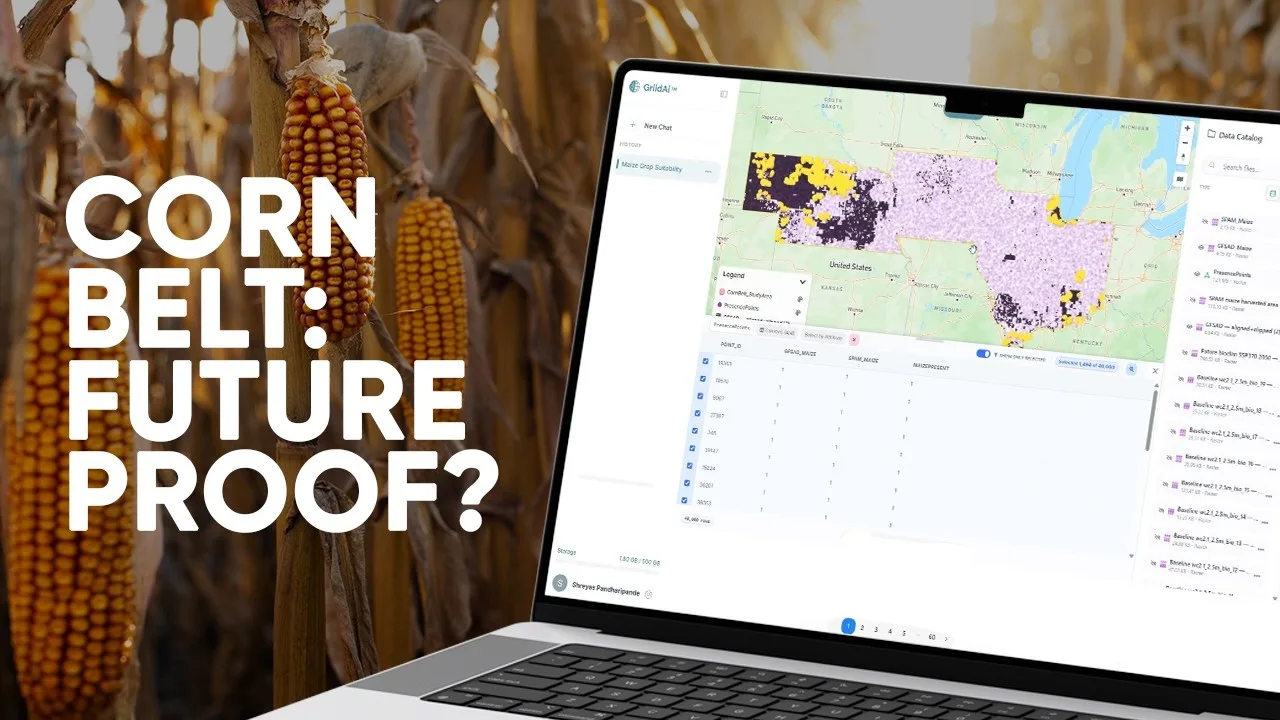
How might suitable maize-growing areas shift under a future climate scenario?
This case study combines bioclimatic variables with crop-distribution information to model maize suitability. The description identifies WorldClim, NASA GFSAD and IFPRI SPAM among the inputs.
The trained model is applied to a future climate scenario, then compared with present conditions to map potential gains and losses. Those maps describe modeled suitability under the selected assumptions; they do not establish future yields.
Source video
Watch the example
Full demo
Watch on YouTube (opens in a new tab)Predicting Future Crop Viability Without Code | GriidAI Workflow
From question to analysis
Data and inputs
- Present and future bioclimatic variables
- Crop extent or distribution data
- A stated climate model, scenario, horizon and study area
Analysis described in the video
- Align climate and crop data and prepare the sampling design.
- Train and evaluate a suitability model against the available observations.
- Apply the model to the selected future climate inputs.
- Compare present and future rasters to locate suitability gains and losses.
Understand the output
Outputs described
- Present and future suitability rasters
- Maps showing modeled suitability change
What to review
- Review sampling, validation and spatial transfer limitations.
- Keep the selected climate scenario and time horizon attached to every result.